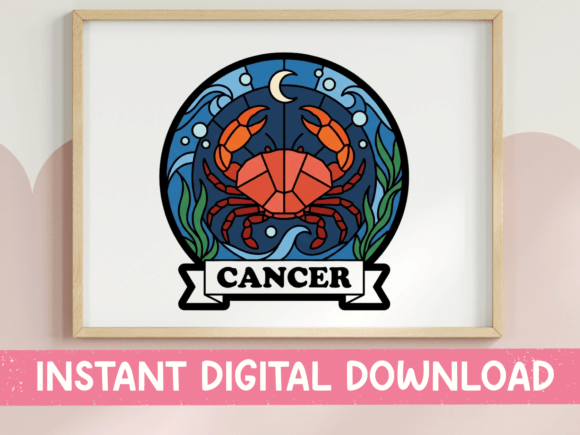
Cancer Zodiac Stained Glass Crab Sticker Review
Pulling a design out of the digital folder always feels like a small moment of truth. You know the one: you stare at the screen, mentally stripping away the preview gloss and asking whether it will actually hold up under a needle at 600 stitches per minute. When I loaded the Cancer Zodiac Stained Glass Crab Sticker into my software, I wasn't just looking at a crab. I was already imagining a dark charcoal sweatshirt, a dense navy tote, and maybe even a lightweight linen pillow cover for a coastal shop client who asks for "moody, not cutesy" every single time.
What hit me first was the color story. A bold orange-red crab sits front and center, and it doesn't whisper. It anchors the whole composition against deep navy blue ocean waves. The moment I saw those segmented stained-glass lines separating the shell details from the claws, I knew this wasn't a flat, lifeless zodiac icon. It has weight. It has a kind of watery drama that feels rare in astrology-themed graphics, especially ones that end up in the T-Shirt Designs category. But the question every embroiderer asks isn't whether a design looks good on screen. It's whether that visual density translates into thread without becoming a troubleshooting nightmare.
First Impression: Moody, Structured, and Surprisingly Refined
Let me be blunt: a lot of stained-glass-inspired graphics look fantastic as printable art but fall apart the second you digitize them for a machine embroidery design. Heavy outlines, tiny floating glass shards, color transitions that rely on gradients rather than solid shapes. This one dodges a lot of those bullets. The crab is centralized and proportioned well, with thick enough separation lines that satin stitch borders can actually breathe. The flanking wave elements on either side frame the center, so when I mock it up on a sweatshirt embroidery layout, it naturally draws the eye inward. No awkward negative space. No weird floating tail that needs to be cropped out at the last minute.
I could immediately see this working as an embroidered patch, especially with a merrowed edge that echoes the stained-glass framing. The layout also screams tote bag design, where the square-ish, badge-like composition sits perfectly on a front pocket or centered above a bottom seam. For Cancer Zodiac Stained Glass Crab Sticker, the personality skews decidedly grown-up. It doesn't feel like a novelty shop impulse buy. It feels like something you'd find in a boutique that sells hand-poured candles and linen wraps.
Translating Stained Glass Into Stitches Without Chaos
The biggest design judgment call here revolves around stitch density. Stained glass looks rely on contrast: dark leading lines and bright jewel-toned fills. In embroidery file terms, that means a careful mix of satin stitch borders and fill stitch interiors. If someone tries to run this at too small a scale, those orange-red claw segments will close up, and the deep navy wave details will turn into one muddy blob. I've been burned before.
Thread color choices will make or break the finished product. The orange-red needs to land somewhere between a burnt persimmon and a true coral, not a traffic cone orange. If you push too bright, it loses the moody depth. The navy blue should be dark but not black, something with a slight sheen so it doesn't swallow the design on dark fabric. I'd likely swatch three different navy threads on a scrap of charcoal sweatshirting before committing. And those tiny white wave crest accents? They look airy in the preview but could read as harsh dots if the stitch angle isn't adjusted. A slight tilt in the fill direction can soften that contrast nicely.
Where This Design Actually Belongs
Enough about theory. Let's talk about where I'd actually sew this out. My brain went to a custom apparel project almost immediately. A unisex pullover hoodie in heathered grey, with the design stitched slightly off-center on the chest. Not dead center. Off-center, because that's where interesting things happen. The crab badge quality of the layout means it reads clearly even at a moderate size, maybe 4 to 5 inches wide. That's the sweet spot for a finished product that looks intentional, not like an afterthought.
Then there's the handmade product angle. I've got a stack of natural canvas tote bags sitting in the studio that practically beg for something with astrological edge. The Cancer Zodiac Stained Glass Crab Sticker would let me create a personalized gift line without custom digitizing every name. Pair it with a simple embroidered initial below the design, and suddenly it's a monogrammed Cancer season gift that feels boutique, not big-box. I can also see this scaled up on a denim jacket back panel for someone who treats their zodiac sign like a quiet declaration, not a loud statement.
A Real Project Walkthrough: The July Birthday Tote
Here's a practical scenario that helps me evaluate any design properly. A regular client emailed last week asking for a last-minute birthday gift for her sister, a July Cancer who collects astrology art but hates anything too shiny. She wanted a heavy-duty canvas market tote, the kind you use at farmer's markets, with a substantial graphic that could handle weekly wear.
I pulled up this stained-glass crab and started asking the questions I always ask. Will the claw details stitch cleanly on textured canvas? Probably, if I use a medium-weight cutaway stabilizer and a topper to prevent the stitches from sinking into the weave. Will the deep navy waves read against a natural oat-colored fabric? Absolutely, because the orange-red crab provides enough luminance to anchor the whole composition. Would the client's sister actually want to carry this? That's the gut check, and it passed. The design walks that line between mystical and modern without tipping into anything kitschy. I can already picture her reaction: surprised, then quiet, then insisting on paying more next time.
Exercising Caution: Where the Design Needs a Lighter Hand
Not every blank is a good candidate. Thin, stretchy fabric like tissue-weight t-shirts will pucker around those dense stained-glass fill areas. I've learned that the hard way on similar geometric designs. The tension required for crisp satin stitch borders simply doesn't forgive flimsy knits. If someone asks for this on a baby embroidery onesie, I would strongly push for a reduced size, maybe 3 inches wide, and use a soft mesh stabilizer that won't irritate delicate skin. Even then, run a test stitchout first.
Dark fabric presents another layer of consideration. The navy wave elements already sit at the deep end of the value scale, so placing this on black or charcoal means you lose that watery background drama entirely. It turns into a floating crab with no context. On a medium wash denim or a khaki tote, the contrast sings. On black, it sinks. Likewise, caps and hats with steeply curved surfaces will distort the symmetrical wave framing. This design thrives on flat or gently curved surfaces: hoodie backs, apron bibs, pillow covers, tea towels, and structured totes.
Frequent washing also deserves a mention. If you're selling this as part of a commercial embroidery line for kitchen towels or baby blankets, the white crest details and thin satin borders need to withstand dozens of cycles. That means choosing colorfast threads, locking stitches securely at every jump, and avoiding overly long satin stitch runs that can snag on zippers or Velcro during laundry.
Designer Notes Before You Stitch
Every experienced embroiderer has a mental checklist that runs before committing thread to fabric. For Cancer Zodiac Stained Glass Crab Sticker, my list looks like this.
- Test on scrap fabric in the same fiber content as your final blank. Canvas and fleece behave differently under tension.
- Check thread color contrast by photographing your stitchout in black and white. If the navy and orange blur into a single grey, adjust one of them.
- Review stitch density in the thinner claw segments. If your software flags anything above 10 stitches per millimeter, back it down slightly.
- Confirm hoop size before resizing. The stained-glass lines need breathing room; crowding them into a 4x4 hoop often kills the wave detail clarity.
- Use proper stabilizer for your fabric type. Knit blanks demand a no-show mesh or a fusible cutaway, not a tearaway that loosens over time.
- Check licensing terms directly with the source. Before selling finished products or offering this as a digital embroidery file to customers, make sure commercial use is explicitly allowed.
- Preview on both light and dark backgrounds using printable mockup templates. What looks luminous on oatmeal linen can vanish on midnight fleece.
How the Design Affects Buyer Perception
A finished embroidered product lives and dies by perceived value. You can stitch the most technically perfect design in the world, but if it looks like something anyone could grab off a discount rack, your customer scrolls past. The Cancer Zodiac Stained Glass Crab Sticker carries an aesthetic that signals thoughtfulness. The stained-glass reference, the astrological specificity, the restrained palette. These details telegraph to a buyer that the maker cares about narrative, not just decoration.
For an Etsy seller or a craft business owner preparing a holiday gift collection, that's everything. A customer buying a Cancer-themed embroidered pillow cover for a sister or best friend isn't just buying a crab. They're buying into a mood. Aquamarine waves, fiery claws, the emotional depth that Cancer signs are known for. If your stitching looks haphazard or your fabric choice feels flimsy, you break that spell. If you execute it cleanly, with thread colors that respect the original stained-glass intent, you build trust that brings repeat buyers back for other zodiac signs.
Presentation amplifies this even further. Photograph the finished piece with a small handwritten tag, maybe a sprig of dried lavender tucked near the corner. Use a printable mockup to show it on multiple products: a structured tote, a linen pillow, a cozy sweatshirt. This visual consistency becomes part of your brand identity. The design itself acts as a design asset, something that defines a collection rather than just filling space on a website.
Commercial Sense and Small Shop Strategy
From a production standpoint, this design offers versatility without chaos. Because the stained-glass style relies on distinct, separated color blocks rather than intricate shading, digitizing time stays manageable. No endless gradient trims, no 18-color thread changes that eat up machine time and inflate per-unit cost. A skilled digitizer can keep this to a reasonable number of thread colors while preserving the moody personality.
That matters for commercial embroidery projects where margins are tight. If you can produce a high-perceived-value Cancer season item in under 15 minutes of stitch time, you're in a healthy place. Shops that sell custom apparel, craft fair products, and personalized gifts will find this slots easily into a seasonal launch or a zodiac collection without requiring exotic supplies. The wide appeal of the stained-glass aesthetic also means it attracts buyers who don't necessarily follow astrology but respond to the art style itself.
I've seen designs that try to be too many things at once: a crab, a zodiac symbol, a constellation pattern, and a watercolor background all mashed together. This one exercises restraint. The crab is the hero. The waves support it. The stained-glass framework gives it structure. Restraint is what makes a graphic work across multiple product categories without looking chaotic. Whether you list it as an embroidered patch, a tote bag design, a holiday gift item, or a sweatshirt embroidery centerpiece, it holds together.
Final Practical Verdict From the Stitch Room
If I were recommending this to another embroidery designer, small business owner, or Etsy seller, I'd tell them to treat the Cancer Zodiac Stained Glass Crab Sticker as a reliable mid-weight design that rewards careful fabric and color choices. It's not a beginner's throwaway. It asks for some thought. But give it a sturdy blank, the right stabilizer, and threads that honor that deep navy-and-burnt-orange contrast, and you'll pull finished products that customers pick up, pause over, and ask about.
Test it on canvas first. Run the claw details at a size where you can actually see the segmented stained-glass lines. Don't rush the thread color matching. Check your licensing so you can confidently sell what you make. And then let that moody little crab do what it was clearly designed to do: turn a simple handmade product into something that feels personal, considered, and quietly beautiful.